
Out-of-Home (OOH) advertising is experiencing a renaissance. For decades, the industry relied on the power of scale and location—the boldest idea on the biggest static canvas won the day. But today, bold ideas are no longer confined to the physical dimensions of a billboard. We have entered the era of “Creative Intelligence,” where data, technology, and contextual awareness are converging to turn passive viewing into dynamic, responsive brand experiences.
OOH is no longer just a format; it is an intelligent, adaptive storytelling medium. By blending classic environments with digital innovation, we are building campaigns that react to the physical world and invite audiences into the narrative.
Welcome to the era of Creative Intelligence—where technology doesn’t replace creativity, but elevates it.
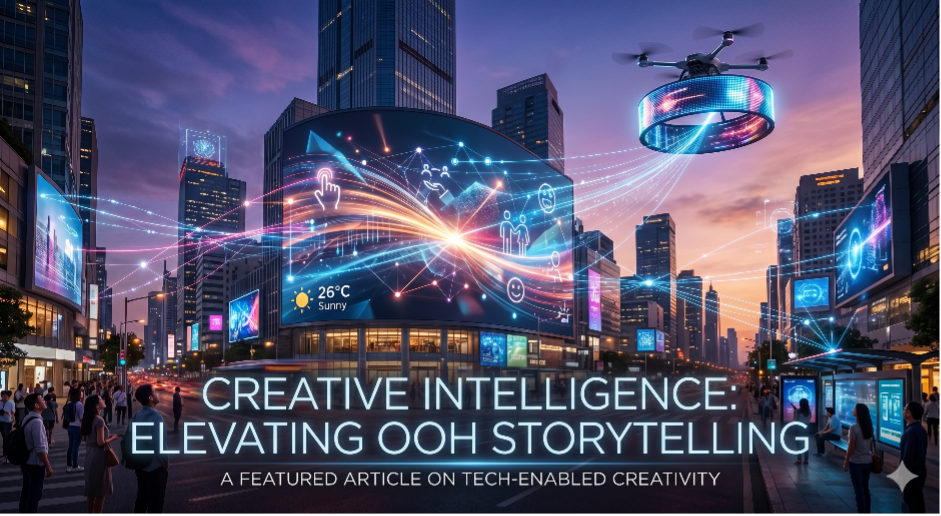
From Clever Screens to Conscious Storytelling
For years, digital innovation in OOH was measured by resolution, screen size, or novelty. Bigger, brighter, sharper. But today, audiences expect more than a spectacle. They expect relevance.
Creative Intelligence represents a shift from broadcasting messages to responding to environments. It’s OOH that listens, adapts, and reacts—content that changes based on time, place, weather, behavior, or participation.
In other words, it’s not about what the screen can do. It’s about what the idea understands.
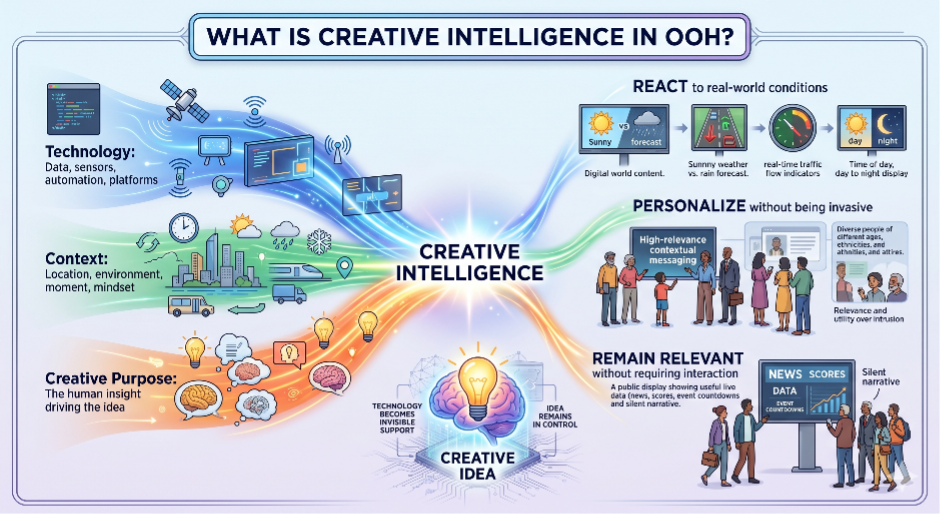
What Is Creative Intelligence in OOH?
Creative Intelligence sits at the intersection of three forces:
- Technology: Data, sensors, automation, and dynamic platforms.
- Context: Location, environment, moment, and mindset.
- Creative Purpose: The human insight driving the idea.
When these align, OOH becomes more than media space—it becomes a living brand experience. This intelligence allows creative work to:
- React to real-world conditions.
- Personalize without being invasive.
- Remain relevant without requiring interaction.
Importantly, the technology is invisible. The idea remains in control.
Where Creative Intelligence Comes to Life
Dynamic Content That Responds to the Moment
Dynamic creative allows brands to serve different messages based on the time of day, location, weather, live data, or audience density:
- A summer message that shifts when temperatures spike.
- A commute-based message that adapts to peak traffic.
- A brand voice that evolves throughout the day.
McDonald’s has repeatedly used weather-reactive digital OOH to dynamically adapt its messaging in real time. Across multiple markets, billboards automatically adjusted creative based on live weather data—promoting McFlurries and cold drinks during heat spikes, or hot coffee and breakfast items when temperatures dropped or rain appeared. The executions required no interaction and no explanation; the right message simply appeared at the right time. The intelligence wasn’t in the technology itself, but in the restraint. By choosing relevance over repetition, McDonald’s ensured its OOH felt timely, helpful, and contextually aware—never static, never forced.
Contextual Triggers in Physical Spaces
Contextual intelligence allows OOH to behave more like a digital platform—without losing its public, shared nature. Screens can respond to movement, proximity, sound, and environmental cues. This doesn’t demand participation; it rewards presence.
Some of the strongest executions are subtle—small changes that make people pause, smile, or feel noticed rather than overwhelmed. A prime example of this approach was a traveling sensory activation for Woolworths SA designed around a “giant biscuit tin.” What made the campaign compelling wasn’t overt visual technology, but how it intelligently engaged sight, hearing, smell, and taste to create an emotional connection. The tins weren’t just packaging; they became a multi-sensory storytelling device, creating keepsakes and conversation starters that extended the brand experience well beyond the physical point of contact. This is Creative Intelligence at a human level—understanding how people emotionally engage with physical environments, and designing around that behavior rather than forcing digital interaction.
Responsive Environments, Not Just Screens
Creative Intelligence is expanding beyond screens into fully immersive environments. Think walk-through installations, spatial illusions, and the use of temperature, light, and perspective as creative tools. These experiences don’t ask for attention—they earn it. Technology enables scale and consistency, while creativity ensures an emotional connection.
Pepsi Max’s Unbelievable bus shelter campaign transformed ordinary waiting spaces into responsive environments using augmented reality. Instead of relying on traditional calls to action, the shelters reacted to the environment in real time—simulating falling meteors, alien invasions, and wild animals appearing within the actual street scene. The experience required no downloads, interaction, or explanation. People simply arrived and discovered something unexpected. Technology operated invisibly to maintain realism, while creativity focused on the emotional response. The result was extended dwell time, organic social sharing, and a memorable brand experience that felt earned rather than advertised.
Participation Without Pressure
Not every intelligent experience needs a QR code or app download. Creative Intelligence also includes passive participation, observational interaction, and shared moments rather than individual tasks.
British Airways’ Look Up campaign turned digital billboards into shared, collective experiences without asking audiences to actively participate. As planes flew overhead, a child on the screen would point up in real time, followed by flight details and the destination. Passersby instinctively looked up together, sharing the moment without downloading, scanning, or engaging individually. The interaction was observational and communal—driven by real-world context rather than user input. By reacting to its environment instead of demanding action, the campaign demonstrated how Creative Intelligence can create powerful shared experiences that feel natural, human, and memorable.
Why Creative Intelligence Matters for Brands
As audiences become more media-savvy, relevance becomes currency. Creative Intelligence allows brands to:
- Reduce creative fatigue.
- Increase dwell time organically.
- Improve message recall.
- Align brand behavior with brand values.
It also helps bridge the gap between performance thinking and brand storytelling—delivering impact without sacrificing imagination.
The Risk: When Technology Leads the Idea
There is a growing risk in our industry: tech-first creativity. When the headline is the technology rather than the idea, the work ages quickly. Audiences don’t remember sensors, screens, or software stacks. They remember how something made them feel.
Creative Intelligence does not mean more technology—it means making better decisions about when and why to use it. The smartest ideas often use technology quietly, almost invisibly.
Various Coca-Cola FIFA World Cup activations have showcased how large-scale global brands can weave intelligence across multiple touchpoints. From OOH placements and experiential builds to social amplification and digital participation, the work demonstrated how a single creative idea can live seamlessly across environments. In many of these executions, OOH was not a standalone medium but a central anchor—attracting attention in the physical world, then feeding momentum into digital channels where fans could continue engaging. The intelligence wasn’t in any single execution, but in how every element was designed to work together. This is where Creative Intelligence becomes most effective: when ideas aren’t siloed, but orchestrated.
Taking Innovation to the Skies: The Aerial Canvas
Perhaps the most striking evolution in OOH tech-enabled creativity is happening above us. We are no longer limited to structures rooted in the ground. Drone technology and aerial digital displays are unlocking the sky as the ultimate, unobstructed canvas. Drones are undoubtedly the next step for innovation in South Africa, as we work alongside the SACAA to navigate legislation and redefine how aerial formats can be utilized safely and effectively.
When deploying aerial innovations, precision and scale are paramount. For instance, executing a world-record aerial display using an exactly 64sqm flying digital screen requires an immense amount of technical orchestration and creative optimization. These tech-enabled formats are highly visible, completely unmissable, and represent the absolute bleeding edge of where OOH is heading. They are not just screens; they are synchronized, floating pixels that can deliver dynamic content and adapt to massive crowd events in real time. It is literally taking digital directly to the consumer!
Innovation Platforms and the Role of WayOut
Platforms like WayOut play a critical role in enabling intelligent creativity at scale. The magic of modern Out-of-Home doesn’t happen in silos; it requires a seamless intersection of vision and practical application. We act as the vital bridge connecting a client’s strategic needs and a creative agency’s Key Visuals (KVs) with the bleeding-edge technology required to bring them to life.
Our approach is deeply collaborative. We don’t just take a brief and execute; we sit at the table with all the teams involved to build and iteratively tweak concepts together. We analyze the creative intent and pair it with our specialized knowledge of where and how to deploy the right technology for maximum physical impact. By aligning everyone involved, we ensure the tech serves the message. When innovation platforms collaborate closely with creatives, technology becomes a storytelling enabler rather than a novelty. That’s where intelligent OOH truly thrives.
Final Thought: The Future Is Intelligent, Not Just Digital
The evolution of OOH isn’t about screens replacing posters or digital replacing static. It’s about intelligence replacing assumption. Creative Intelligence invites us to ask better questions:
- Who is here right now?
- What moment am I entering?
- What is the most relevant thing I can say—or show—here?
I believe the best innovation doesn’t always come from the technology itself; it comes from the teams behind the project working together as one. It is never just the creative team or just the clients. It is Media, Client, Creative, and Production each bringing their specialized knowledge of what is trying to be executed and why, all to create the absolute best experience for the consumer. It is about making that experience something that lives with them long after they walk away.
The future of OOH storytelling isn’t louder. It’s smarter.