
Out-of-Home (OOH) is no longer constrained by inventory alone, it is constrained by infrastructure. While digital screens have scaled rapidly, the ability to connect, manage, and monetise those screens across markets has not kept pace. This gap, not inventory, is what has historically limited OOH growth. Moving Walls provides the intelligence layer that enables interoperable, data-driven coordination across OOH networks, with digital formats playing a key role in enabling more dynamic and measurable execution.
As digital screens continue to expand across urban environments, a new intelligence layer is emerging within the OOH ecosystem. Data signals, audience measurement tools, and connected technology platforms are enabling media owners to capture higher utilisation, attract international campaigns, and prove inventory value with data-backed confidence. This shift is transforming OOH as a whole, with digital formats introducing more dynamic planning, execution, and measurement capabilities.
This shift is transforming DOOH from a static planning medium into a more dynamic and measurable channel.
Across markets, media owners are increasingly connecting their screen networks through technology platforms like Moving Walls that enable smarter planning, coordinated execution, and greater visibility into campaign delivery.
Unlike traditional siloed systems, this intelligence layer operates on an agnostic infrastructure model where media owners are not locked into a single ecosystem but can connect inventory, demand, and measurement tools flexibly.
This “Agnostic OS” approach allows media owners to integrate existing systems, participate in global demand pipelines, and maintain control over how their inventory is packaged and monetised. At an operational level, this agnostic approach works by normalising fragmented data structures across markets. Screen metadata, campaign formats, and delivery protocols are standardised into a unified schema, allowing inventory from different media owners and regions to be managed within a single system.
This ensures that campaigns can be deployed consistently across markets without requiring manual adaptation for each local system while still preserving the flexibility for market-specific requirements.
The Growing Demand for Data-Driven OOH
As advertisers become more performance-driven, expectations around accountability, measurement, and return on ad spend have evolved.
Marketers today expect to know:
- Where campaigns are running
- When ads are delivered
- Which audiences are exposed to the media
- How campaigns perform across markets and locations
In the past, answering these questions consistently across large OOH networks was difficult. Media owners often operated different systems for scheduling, creative management, and reporting, which made large-scale campaigns complex to coordinate.
With the rise of digital screens and cloud-based platforms, the industry is now able to connect these systems through a unified infrastructure.
At a functional level, this intelligence layer is delivered through platforms like MW Studio, which enables media owners to normalise inventory across formats, locations, and markets.
MW Studio standardises screen metadata, centralises campaign scheduling, and unifies creative management — allowing fragmented inventory to be managed within a single system.
This eliminates manual coordination across markets and allows campaigns to scale seamlessly across networks.
Where OOH is Evolving Further
- Greater focus is being placed on understanding audience engagement beyond traffic volumes
- Pricing models are increasingly incorporating real audience behaviour and movement patterns
- Campaign planning is evolving from static setups to more dynamic and responsive strategies
- Cross-market activations are becoming more coordinated through connected platforms
Media owners who can meet these expectations are increasingly winning a larger share of budgets.
This shift is already visible in markets like Japan. With Jeki, Moving Walls enabled the integration of digital inventory into a connected ecosystem, allowing campaigns to be planned and measured with greater consistency across high-density urban environments.
This demonstrates how connected infrastructure can improve both inventory utilisation and measurement consistency in high-density OOH environments
Managing the Complexity of Multi-Market Campaigns
As OOH continues to digitise and DOOH networks expand globally, advertisers are increasingly interested in campaigns that reach audiences across multiple cities and countries simultaneously
However, executing these campaigns introduces significant operational complexity.
Each market may operate with different screen formats, scheduling systems, and technical requirements. Creative assets may need to be adapted to suit multiple resolutions and playback formats. Campaign timelines must be coordinated across different time zones, networks, and operational teams.
Without the right technology infrastructure, managing these variables across markets can quickly become challenging.
Connected platforms help simplify this process by creating a shared framework through which media owners can integrate their inventory, standardise campaign delivery, and coordinate execution across networks.
This infrastructure allows campaigns to be deployed across diverse environments while maintaining consistency in delivery and reporting.
A Pan-African Chinese New Year DOOH Activation
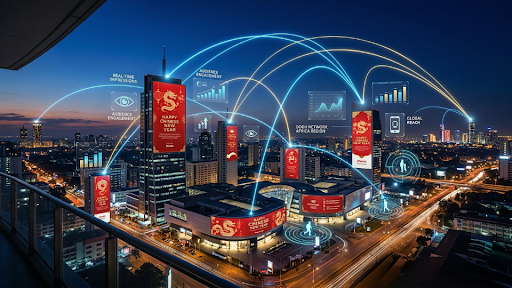
This shift is also unlocking a major opportunity: cross-market demand. Instead of selling inventory market by market, media owners can now plug into campaigns that span regions or even continents.
A clear example is the Pan-African Chinese New Year campaign. To deliver continent-wide visibility, the activation ran across 567 digital screens spanning 10 African markets, including South Africa, Uganda, Nigeria, Tanzania, Ghana, Botswana, Namibia, Zambia, Lesotho, and Zimbabwe.
Each market participated in the campaign by displaying promotional creatives for the Spring Festival Gala across its digital screen network, creating a coordinated activation across the continent.
The campaign ran for one day in each participating market, ensuring that audiences across multiple cities experienced the cultural celebration through DOOH media environments.
Inventory was never the constraint fragmented systems limited the ability to synchronise execution across independent media owner networks.
This highlights how connected platforms enable media owners to scale operations while maintaining control and consistency across digital networks.
The Technology Layer Behind Cross-Market Execution
The real value of connected infrastructure lies not in access to screens, but in the ability to coordinate them as a single network.
This requires a system that can ingest diverse screen formats, standardise delivery protocols, and enable real-time visibility across markets — while still allowing local flexibility.
In practice, this means a campaign deployed across multiple markets behaves like one coordinated activation, rather than isolated executions.
Measurement and Visibility in the OOH Ecosystem
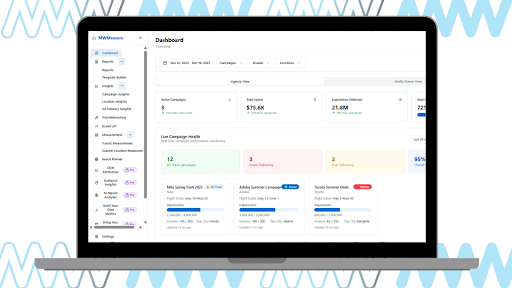
Moving Walls embeds measurement directly into campaign execution, enabling continuous visibility into delivery, exposure, and performance across markets. By integrating anonymised mobility data, device signals, and location intelligence, OOH campaigns can now be evaluated continuously rather than retrospectively, with digital environments enabling more granular insights and optimisation.
This shifts OOH from static reporting to a live, data-informed optimisation environment.
These measurement capabilities help the industry move toward greater transparency by providing insights such as:
- Estimated audience reach
- Exposure frequency
- Campaign delivery verification
- Location-level performance trends
For advertisers, this data provides greater confidence that campaigns are delivered as planned. For media owners, measurement tools create new opportunities to demonstrate the value and performance of their inventory.
Audience measurement technologies analyse real-world footfall and behavioural patterns around screen locations, enabling more accurate estimates of audience exposure and engagement. As a result, these insights are becoming an important part of how OOH campaigns are planned and evaluated, with digital formats enabling deeper measurement capabilities.
For media owners, this intelligence layer also creates practical advantages. Connected platforms make it easier to manage screen networks, participate in regional campaigns, and provide advertisers with clearer reporting on campaign delivery, helping attract new demand while improving operational efficiency.
Moving Walls’ measurement framework is built on four key layers:
- Location intelligence to understand the environment around each screen
- Mobility data to analyse audience movement patterns
- Exposure modelling to estimate visibility and dwell time
- Delivery verification to confirm campaign execution
Together, these layers provide a structured and transparent approach to evaluating campaign performance across markets.
Collaboration Across Media Owner Networks
Large-scale regional campaigns also highlight the growing importance of collaboration within the OOH ecosystem.
When multiple media owners connect their inventory through shared platforms, their combined networks can offer advertisers broader geographic reach while maintaining local audience engagement.
In the Pan-African Chinese New Year activation, participation from media owners across multiple countries allowed the campaign to achieve continent-wide visibility while leveraging the unique audience environments of each market.
This type of collaboration demonstrates how connected media owner ecosystems can unlock new opportunities for regional and global advertisers seeking scale.
The Future of Data-Driven DOOH
The next phase of DOOH will not be won by those who own the most screens — but by those who can make those screens interoperable, measurable, and accessible to global demand.
For media owners, this is no longer a question of digitisation, but of infrastructure strategy.
With platforms like MW Studio and MW Influence, media owners can transform screen networks into interoperable, measurable, and globally accessible media environments.